Every admission season, we speak with parents who ask the same question.
"These activities are fine, but when will my child focus on academics?"
It's a fair question. Entrance exams are competitive. IIT-JEE and NEET seats are limited. A parent watching their child spend an hour in calligraphy class or kung fu training naturally wonders whether that hour belongs in a textbook instead.
But what if the research shows the opposite is true? What if removing arts, music, and sports from a child's routine doesn't improve their scores, but quietly damages the very cognitive systems that learning depends on?
The Pressure That's Making Children Perform Worse
Most parents who reduce co-curricular activities do so with the best intentions.
The reasoning is simple: more study hours equal better grades. So the painting class goes. Then the music practice. Then the Saturday sport. The child sits at the desk for longer stretches, and the parent feels reassured that things are moving in the right direction.
But by Class 9 or 10, something doesn't add up. The child who was once curious starts showing disengagement. Retention drops. Exam anxiety increases. Teachers report that the student knows the content but freezes under pressure.
This is not a learning problem. It's a neurological one. And it traces directly back to what was taken away.
Why the "More Study Time" Logic Breaks Down
The brain doesn't work like a storage device where you pour in more information and it stays there.
Learning is a biological process. For information to move from short-term to long-term memory, the brain requires cycles of stress and recovery. Physical activity triggers the release of BDNF, a protein researchers at Harvard Medical School have described as acting like fertiliser for brain cells, directly supporting memory formation and cognitive flexibility.
When a child spends six to eight hours in academic input with no physical or creative outlet, the brain doesn't process more. It processes less. Fatigue sets in. Attention narrows. The additional study hours become diminishing returns.
So the problem isn't a lack of effort. The problem is a fundamental misunderstanding of how the brain learns.
The Shift Most Parents Haven't Considered
Here's what 15 years of watching children grow at Sanskar has shown: the students who perform best at the IIT Foundation level are not the ones who studied the most. They're the ones who trained the hardest.
Not academically. Physically. Creatively. Mentally.
The child who practices calligraphy for 30 minutes every morning is developing sustained attention, fine motor control, and the tolerance for repetition that competitive exam preparation demands. The child in kung fu is learning to manage failure, reset quickly, and try again within the same session. Every day. Without being told to.
These aren't soft skills. They're cognitive habits. And they're almost impossible to teach in a classroom directly.
From Our Experience: At Sanskar, we've consistently seen that NCC cadets perform more steadily during exam periods than their peers. The discipline, early morning routine, and structured pressure of NCC training builds a kind of mental resilience that carries directly into how a student handles a three-hour paper. It's not a coincidence. It's a pattern we've observed across two full batches of cadets.
What the Research Actually Says
The connection between physical activity and academic performance is well-documented and growing stronger.
A landmark study published in the journal Pediatrics found that children who participated in daily physical activity scored measurably higher on concentration tests and showed fewer behavioural interruptions in class. The relationship between physical fitness and academic achievement in children held even after controlling for socioeconomic factors.
Music training shows similar results. Research from the University of Vermont College of Medicine, drawing on brain scans of 232 children, found that children who learned to play an instrument showed stronger development in the cortical areas responsible for attention, emotional control, and executive function. These are the same functions that determine how a student performs under exam pressure, not just how much content they've memorised.
Arts and craft work, including calligraphy and drawing, develop what cognitive scientists call visuospatial reasoning, the ability to mentally manipulate shapes, patterns, and structures. This is the exact cognitive skill that differentiates average performers from top scorers in geometry, physics, and chemistry.
The research doesn't suggest that these activities are extras. It suggests they're foundations.
Expert Tip: The key is not whether a child does music or sport. It's whether the activity is structured enough to require repetition, discipline, and progressive difficulty. A child passively watching a sport gains nothing neurologically. A child actively practicing skating, even for 45 minutes three times a week, is building balance, proprioception, and the tolerance for controlled failure that turns into academic persistence.
How Sanskar Builds Academic Performance Through the Whole Child
At Sanskar Innovative School, this understanding isn't new. It's been the design principle since the school was established on its 4-acre campus in Medchal in 2012.
The co-curricular programme is structured around activities that we know build specific cognitive and character capacities.
Calligraphy trains patience and attention. Sitting with a single stroke until it's right is one of the best preparations for the long, precise work of competitive exam preparation. Students who practice calligraphy regularly tend to write more clearly under pressure and make fewer careless errors.
Kung fu builds self-regulation and resilience. The training requires a child to fall, reset, and continue, not once, but dozens of times in a single session. Over months, this builds the psychological architecture that prevents students from shutting down during difficult exam papers.
Skating develops body awareness, coordination, and confidence. The visible courage it takes for a child to stay upright on skates translates invisibly into the willingness to attempt problems they haven't seen before.
Yoga and meditation, practiced every morning for residential students, have a direct, well-documented impact on cortisol levels, which is the stress hormone that impairs memory retrieval. Students who begin their day with yoga literally enter their first class with better access to what they already know.
The NCC Army Wing, affiliated to 1 Artillery Battery, introduces systematic discipline through drill, physical fitness, and character training under a qualified Associate NCC Officer. The structure and seriousness of NCC training builds a quality in students that no classroom lecture can produce: the ability to act decisively under pressure while maintaining composure.
Music, dance, and drama develop emotional intelligence and the capacity for public expression. Our students speak in front of the full class at the end of every chapter in every subject. This isn't incidental. It's intentional preparation for a world where communication matters as much as knowledge.
Trekking, led by the NCC officer into the green terrain around Medchal, builds teamwork, problem-solving, and physical endurance. Students who've trekked tend to approach unfamiliar academic challenges with more curiosity and less avoidance.
None of this happens by accident. The balance between academic rigour and co-curricular depth is what the school was designed to hold.
The Real Strategy Was Never Just the Syllabus.
It's worth saying directly: Sanskar's IIT-JEE and NEET Foundation programme begins from Grade 6. The academic expectations are high, and the training is serious.
But the students who do well in that programme, the ones who sustain their performance from Class 6 through Class 12, are not the ones whose evenings were spent entirely at a desk. They're the ones who had enough variety in their day to stay mentally fresh, enough physical activity to keep the brain in learning mode, and enough structured challenge outside the classroom to build the character that academic pressure demands.
Hundreds of alumni have gone on to IITs and top medical colleges. Several are now at ISRO, DRDO, and in the Armed Forces. They came from this campus, this programme, and this balanced approach.
Final Takeaway: Based on more than 15 years of observing student development at Sanskar Innovative School, the single most important factor in sustained academic performance is not the number of study hours. It's the quality of the whole day. Children who train their bodies, develop creative skills, and participate in structured co-curricular activity consistently outperform children who study longer but rest less. If you're choosing a school for your child, don't look for the one that sacrifices everything for academics. Look for the one that understands why it doesn't have to.
Curious about how this approach works in practice? Visit the Sanskar Innovative School campus in Medchal, speak with current students and parents, and see the environment for yourself. We welcome you to come and explore.
"These activities are fine, but when will my child focus on academics?"
It's a fair question. Entrance exams are competitive. IIT-JEE and NEET seats are limited. A parent watching their child spend an hour in calligraphy class or kung fu training naturally wonders whether that hour belongs in a textbook instead.
But what if the research shows the opposite is true? What if removing arts, music, and sports from a child's routine doesn't improve their scores, but quietly damages the very cognitive systems that learning depends on?
The Pressure That's Making Children Perform Worse
Most parents who reduce co-curricular activities do so with the best intentions.
The reasoning is simple: more study hours equal better grades. So the painting class goes. Then the music practice. Then the Saturday sport. The child sits at the desk for longer stretches, and the parent feels reassured that things are moving in the right direction.
But by Class 9 or 10, something doesn't add up. The child who was once curious starts showing disengagement. Retention drops. Exam anxiety increases. Teachers report that the student knows the content but freezes under pressure.
This is not a learning problem. It's a neurological one. And it traces directly back to what was taken away.
Why the "More Study Time" Logic Breaks Down
The brain doesn't work like a storage device where you pour in more information and it stays there.
Learning is a biological process. For information to move from short-term to long-term memory, the brain requires cycles of stress and recovery. Physical activity triggers the release of BDNF, a protein researchers at Harvard Medical School have described as acting like fertiliser for brain cells, directly supporting memory formation and cognitive flexibility.
When a child spends six to eight hours in academic input with no physical or creative outlet, the brain doesn't process more. It processes less. Fatigue sets in. Attention narrows. The additional study hours become diminishing returns.
So the problem isn't a lack of effort. The problem is a fundamental misunderstanding of how the brain learns.
The Shift Most Parents Haven't Considered
Here's what 15 years of watching children grow at Sanskar has shown: the students who perform best at the IIT Foundation level are not the ones who studied the most. They're the ones who trained the hardest.
Not academically. Physically. Creatively. Mentally.
The child who practices calligraphy for 30 minutes every morning is developing sustained attention, fine motor control, and the tolerance for repetition that competitive exam preparation demands. The child in kung fu is learning to manage failure, reset quickly, and try again within the same session. Every day. Without being told to.
These aren't soft skills. They're cognitive habits. And they're almost impossible to teach in a classroom directly.
From Our Experience: At Sanskar, we've consistently seen that NCC cadets perform more steadily during exam periods than their peers. The discipline, early morning routine, and structured pressure of NCC training builds a kind of mental resilience that carries directly into how a student handles a three-hour paper. It's not a coincidence. It's a pattern we've observed across two full batches of cadets.
What the Research Actually Says
The connection between physical activity and academic performance is well-documented and growing stronger.
A landmark study published in the journal Pediatrics found that children who participated in daily physical activity scored measurably higher on concentration tests and showed fewer behavioural interruptions in class. The relationship between physical fitness and academic achievement in children held even after controlling for socioeconomic factors.
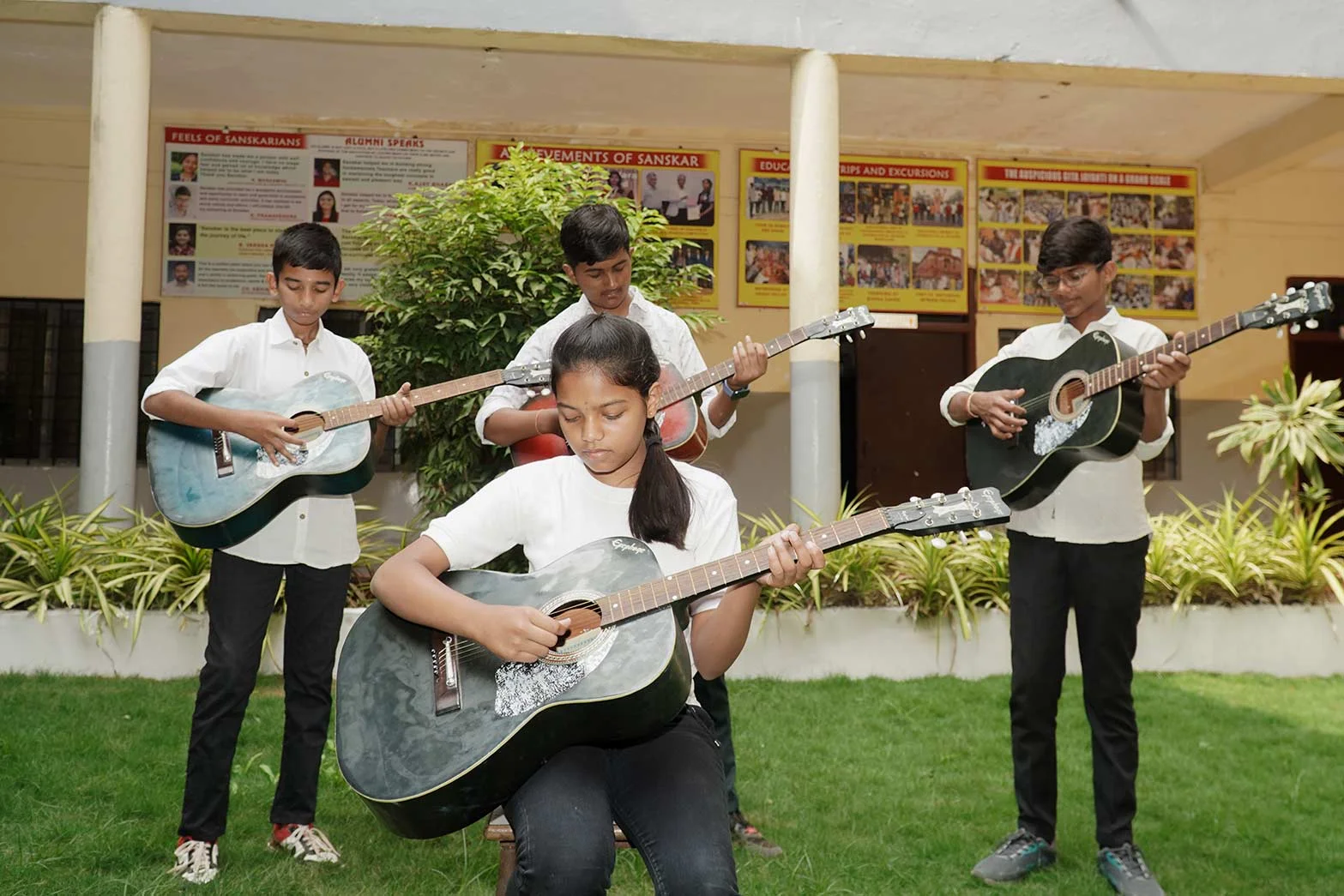
Music training shows similar results. Research from the University of Vermont College of Medicine, drawing on brain scans of 232 children, found that children who learned to play an instrument showed stronger development in the cortical areas responsible for attention, emotional control, and executive function. These are the same functions that determine how a student performs under exam pressure, not just how much content they've memorised.
Arts and craft work, including calligraphy and drawing, develop what cognitive scientists call visuospatial reasoning, the ability to mentally manipulate shapes, patterns, and structures. This is the exact cognitive skill that differentiates average performers from top scorers in geometry, physics, and chemistry.
The research doesn't suggest that these activities are extras. It suggests they're foundations.
Expert Tip: The key is not whether a child does music or sport. It's whether the activity is structured enough to require repetition, discipline, and progressive difficulty. A child passively watching a sport gains nothing neurologically. A child actively practicing skating, even for 45 minutes three times a week, is building balance, proprioception, and the tolerance for controlled failure that turns into academic persistence.
How Sanskar Builds Academic Performance Through the Whole Child
At Sanskar Innovative School, this understanding isn't new. It's been the design principle since the school was established on its 4-acre campus in Medchal in 2012.
The co-curricular programme is structured around activities that we know build specific cognitive and character capacities.
Calligraphy trains patience and attention. Sitting with a single stroke until it's right is one of the best preparations for the long, precise work of competitive exam preparation. Students who practice calligraphy regularly tend to write more clearly under pressure and make fewer careless errors.
Kung fu builds self-regulation and resilience. The training requires a child to fall, reset, and continue, not once, but dozens of times in a single session. Over months, this builds the psychological architecture that prevents students from shutting down during difficult exam papers.
Skating develops body awareness, coordination, and confidence. The visible courage it takes for a child to stay upright on skates translates invisibly into the willingness to attempt problems they haven't seen before.
Yoga and meditation, practiced every morning for residential students, have a direct, well-documented impact on cortisol levels, which is the stress hormone that impairs memory retrieval. Students who begin their day with yoga literally enter their first class with better access to what they already know.
The NCC Army Wing, affiliated to 1 Artillery Battery, introduces systematic discipline through drill, physical fitness, and character training under a qualified Associate NCC Officer. The structure and seriousness of NCC training builds a quality in students that no classroom lecture can produce: the ability to act decisively under pressure while maintaining composure.
Music, dance, and drama develop emotional intelligence and the capacity for public expression. Our students speak in front of the full class at the end of every chapter in every subject. This isn't incidental. It's intentional preparation for a world where communication matters as much as knowledge.
Trekking, led by the NCC officer into the green terrain around Medchal, builds teamwork, problem-solving, and physical endurance. Students who've trekked tend to approach unfamiliar academic challenges with more curiosity and less avoidance.
None of this happens by accident. The balance between academic rigour and co-curricular depth is what the school was designed to hold.
The Real Strategy Was Never Just the Syllabus.
It's worth saying directly: Sanskar's IIT-JEE and NEET Foundation programme begins from Grade 6. The academic expectations are high, and the training is serious.
But the students who do well in that programme, the ones who sustain their performance from Class 6 through Class 12, are not the ones whose evenings were spent entirely at a desk. They're the ones who had enough variety in their day to stay mentally fresh, enough physical activity to keep the brain in learning mode, and enough structured challenge outside the classroom to build the character that academic pressure demands.
Hundreds of alumni have gone on to IITs and top medical colleges. Several are now at ISRO, DRDO, and in the Armed Forces. They came from this campus, this programme, and this balanced approach.
Final Takeaway: Based on more than 15 years of observing student development at Sanskar Innovative School, the single most important factor in sustained academic performance is not the number of study hours. It's the quality of the whole day. Children who train their bodies, develop creative skills, and participate in structured co-curricular activity consistently outperform children who study longer but rest less. If you're choosing a school for your child, don't look for the one that sacrifices everything for academics. Look for the one that understands why it doesn't have to.
Curious about how this approach works in practice? Visit the Sanskar Innovative School campus in Medchal, speak with current students and parents, and see the environment for yourself. We welcome you to come and explore.